Pump repair pricing is not the pump price plus a guess. A service call can consume a truck, a technician, diagnostic time, electrical testing, a second crew member, lifting equipment, parts sourcing, and a return trip before the repair is even known.
Quick answer: Price well pump repair jobs from a loaded cost floor, then adjust for scope certainty and risk. Charge for diagnosis, travel, productive labor, equipment, parts, testing, compliance, warranty, and profit. Use flat-rate pricing only for repeatable known repairs; use time-and-materials or not-to-exceed pricing when failure, depth, access, or return work is uncertain.

If your company prices every call with one hourly rate, or quotes from the replacement part alone, the problem is probably not that your rate is too high. Your price card is missing costs.
This guide gives you a contractor-facing method for building the card. It does not publish a national price list because a fair rate depends on your payroll, territory, equipment, suppliers, licenses, production time, and actual job history.

What should a well pump repair price recover?
A repair price should recover the cost of producing the result, the cost of carrying the business, the risk of an uncertain scope, and the profit required to keep the service line viable.
Start with this structure:
Selling price
= service or diagnostic charge
+ loaded field labor
+ travel and vehicle recovery
+ equipment or rig recovery
+ parts and consumables
+ testing, disinfection, permits, or inspection when applicable
+ risk or warranty reserve
+ profit
That is a pricing structure, not a universal formula for every invoice. Some companies put travel inside a service charge. Some put equipment inside a labor rate. Some use a single flat repair price. The customer does not need to see your internal accounting model, but you need one before you decide what the repair is worth.
The most common mistake is counting only visible job costs. The technician is on site, so the estimator counts technician wages and the replacement part. The estimator forgets dispatch, non-billable drive time, payroll burden, truck ownership, insurance, inventory, training, estimating, software, warranty returns, and the hours lost when a job runs long.
The U.S. Small Business Administration separates fixed costs from variable costs in break-even analysis and uses fixed costs divided by price minus variable cost to calculate break-even units. It also advises separating semi-variable costs when possible. That logic applies to service work: a repair price should not be built from wage alone because the business must recover costs that do not appear on the jobsite. The SBA break-even guidance is a useful accounting check, not a pump-industry rate schedule.
Your billable labor rate is a recovery tool, not the technician's wage.
Which costs belong in the price card?
Use one worksheet for the cost floor and another for the customer-facing price. The first keeps the company honest. The second keeps the quote readable.
| Cost layer | What to capture | Typical pricing home |
|---|---|---|
| Dispatch and diagnosis | Intake, scheduling, diagnostic instruments, initial tests, documentation | Service or diagnostic charge |
| Field labor | Paid crew time, payroll burden, supervision, productive-hour target | Hourly labor or flat-rate production time |
| Travel | Vehicle cost, paid travel where applicable, tolls, distance, territory density | Included radius, zone, travel line, or mobilization |
| Equipment | Pulling rig, truck, generator, test equipment, lifting gear, special tools | Equipment line, daily rate, or built into repair class |
| Parts | Pump, motor, control box, tank, switch, cable, pipe, fittings, freight | Parts line using a consistent handling and warranty policy |
| Consumables | Sealants, wire connectors, disinfectant, fasteners, test supplies, cleanup | Materials line or repair package |
| Compliance | Permit, inspection, laboratory coordination, required records | Pass-through, allowance, or separate approved line |
| Risk | Unknown diagnosis, access, depth, return visit, after-hours, warranty | Contingency policy or conditional scope |
| Profit | Return on the capital, capacity, and risk accepted | Margin or markup after the cost floor |
Do not force every layer into every job. A known pressure-switch repair may not need a rig or a permit. A pump pull may need a crew, removal equipment, testing, and a different warranty policy. The price card should make the difference visible before someone promises a number.
How do markup and margin differ?
Markup is added to cost. Margin is the portion of the selling price left after cost. They are not interchangeable.
Price with markup = cost x (1 + markup percentage)

Price at target gross margin = cost / (1 - target gross margin)
If an estimator enters a target margin into a markup field, the company will underprice the job. Put the chosen method at the top of the workbook, label the cells clearly, and have the owner or bookkeeper verify the setup.
A price book does not need to show the customer every internal percentage. It does need a consistent internal rule. If one estimator marks up parts, another uses a margin, and a third absorbs truck costs into labor, the company cannot compare jobs or learn from its records.
How do you calculate a loaded billable labor rate?
Calculate the rate from annual loaded labor cost divided by realistic annual billable hours, then test it against completed-job results.
Use this worksheet:
Annual loaded field labor cost
= wages or owner field compensation
+ payroll taxes and benefits
+ paid training and meetings
+ field supervision
+ uniforms and required personal equipment

Annual billable hours
= paid field hours
- vacation, holidays, sick time, training, meetings
- shop time, parts runs, estimates, callbacks, and other non-billable time

Loaded labor rate
= annual loaded field labor cost / annual billable hours
If the company uses a two-person crew, calculate the crew rate and the man-hour rule separately. A quote that says “one hour” may mean one clock hour with two people, or two man-hours. That distinction matters.
The public Township of Wall, New Jersey pump-maintenance bid is useful here because it separates a minimum basic service charge from straight-time, overtime, weekend, and holiday labor. It also calls out the pump-removal rig and truck separately. The document is one public contract, not a national standard, but the decomposition is a practical reminder that a service line can have more than one recoverable clock. The Wall bid form even distinguishes work under two man-hours from work above that threshold in its own terms.
What should you do when billable hours are uncertain?
Use the last twelve months of time records if they are available. Separate service calls, pump pulls, replacements, inspections, estimates, callbacks, warranty work, and non-billable shop time. If your records are weak, do not hide the uncertainty inside a low hourly rate. Mark the data gap and start measuring.
The goal is not to make the denominator look large. A technician who is paid for a full day but can only sell a portion of that day has a higher required billable rate than an estimator who treats every paid hour as billable.

Track these fields by job:
- scheduled hours;
- drive time and distance;
- on-site time;
- crew members and man-hours;
- parts-run or procurement time;
- estimate and documentation time;
- return or callback time;
- warranty time;
- collected revenue and unpaid balance.
If the company has employees, review travel treatment with payroll. The U.S. Department of Labor says travel during normal work hours is compensable work time, while ordinary home-to-work travel generally is not under the conditions described in its guidance. That is a wage-and-hour issue, not permission to invoice every mile to a customer. Read the Department of Labor travel-time guidance and confirm how your actual vehicle, dispatch, and employee arrangement is treated.
Which type of pump repair call are you pricing?
Classify the call before you choose the price structure. A surface diagnosis with known access is not economically equivalent to an unknown submersible failure.
Use this call-class ladder.
| Call class | What is known before dispatch? | Safer initial price structure | Main risk to capture |
|---|---|---|---|
| Diagnostic only | Symptom is known, failure is not | Diagnostic charge plus defined time or minimum | The visit may not produce a repair scope |
| Known surface repair | Component, access, and likely procedure are verified | Flat rate or service minimum plus repair price | Hidden wiring, tank, valve, or system fault |
| Surface system repair | Several visible components or pressure issues are involved | T&M or not-to-exceed with approval points | Diagnosis expands after testing |
| Submersible access or pull | Depth, access, equipment, and condition may be incomplete | Diagnostic/access phase, then T&M or written scope | Crew, rig, drop pipe, cable, depth, and return work |
| Replacement or rehabilitation | A replacement or larger intervention is likely | Written estimate with explicit assumptions and exclusions | Compatibility, code, testing, disposal, and warranty |
| Emergency or after-hours | Urgency and schedule disruption are known; failure may not be | Emergency service policy plus defined labor and authorization | Schedule displacement, fatigue, parts availability, and follow-up |
Do not let a caller's diagnosis determine your scope. “The pump is bad” may describe no water, low pressure, a tripped breaker, a failed pressure switch, a waterlogged tank, a leak, a control problem, or a well-yield problem. Ask enough questions to route the call, but do not promise the repair price before the evidence supports it.
What should the intake call collect?
The intake form should collect facts that change time, equipment, crew, parts, and risk.
- What is the symptom: no water, low pressure, cycling, air, noise, discolored water, constant running, or a leak?
- When did it start, and did it follow a storm, power event, freeze, flooding, excavation, or other site event?
- Is the pump surface-mounted or submersible, and is the brand or model known?
- What is the well depth, pump setting depth, static water level, or last service record if available?
- Where is the well head, tank, control box, and access route for the truck or rig?
- Is the company being asked to diagnose, repair, replace, test, disinfect, inspect, or provide a written estimate?
- Is the water used for drinking, irrigation, livestock, commercial production, or another purpose?
- Is the work within the service territory, and is the requested arrival time actually available?
The form is not a technical diagnosis. It is a pricing and dispatch screen. Missing answers should increase uncertainty, not disappear from the quote.
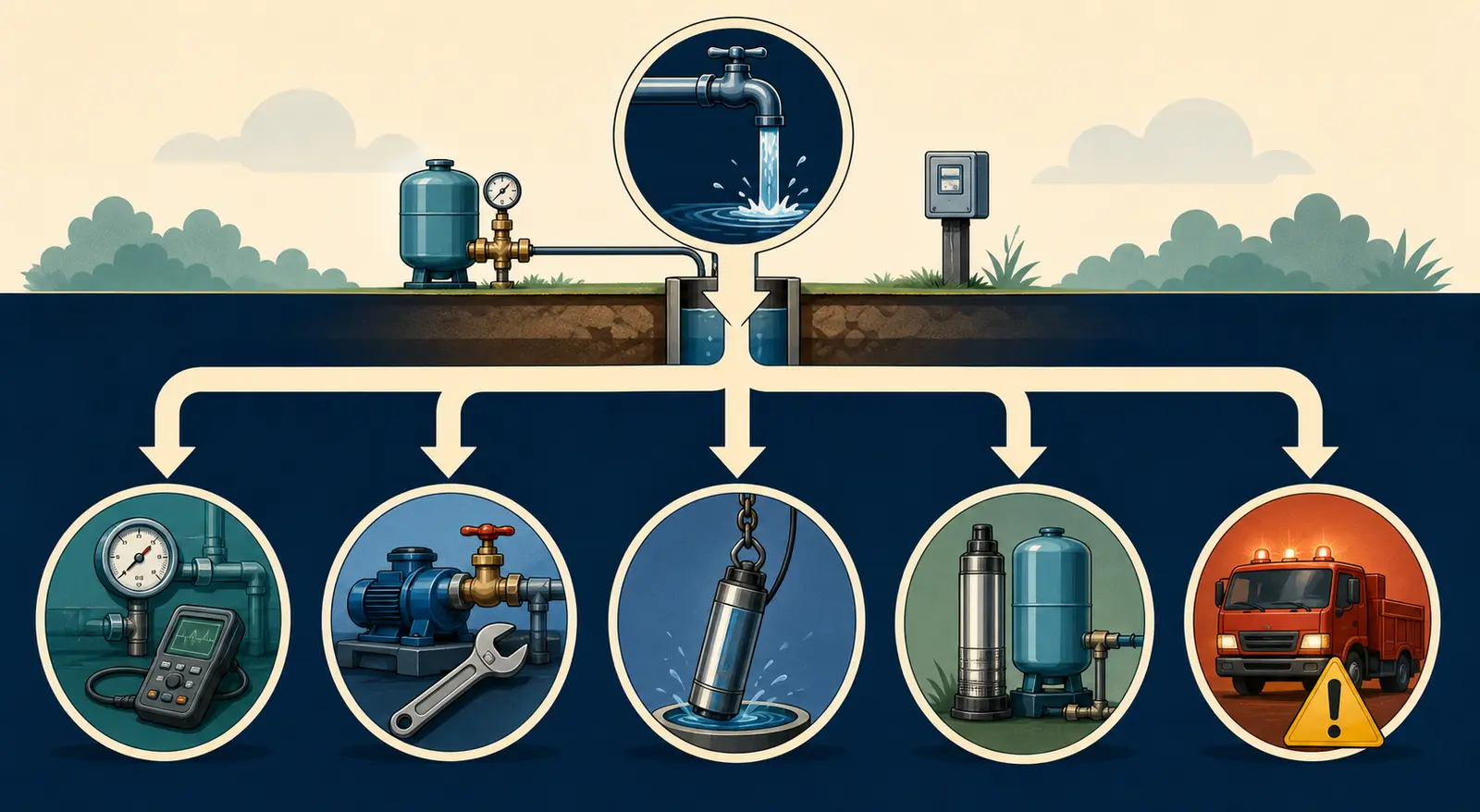
When should you use a service or diagnostic charge?
Use a service or diagnostic charge when the company is selling access to trained diagnosis, not merely a replacement component.
A sensible diagnostic charge can recover:
- dispatch and scheduling;
- the truck roll and territory cost;
- the first defined block of diagnostic time;
- instruments and ordinary consumables;
- the technician's diagnosis and written findings;
- office time to prepare the next estimate.
The customer-facing description should be specific. “Service call” is vague. “Diagnostic visit includes arrival, system inspection, electrical and pressure checks within the accessible system, findings, and a repair recommendation; repair work is quoted separately” is easier to approve and easier to defend.
Should the diagnostic charge be credited toward repair?
It can be, but only if the policy is clear and the repair price still works.
Three workable policies are:
- No credit: the diagnostic is a stand-alone service with its own deliverable. Use this when diagnosis can require a report, testing, or a separate estimate.
- Full credit: the diagnostic is applied to an approved repair within a defined time window. Use this when the repair scope is commonly discovered and completed on the same visit.
- Conditional credit: a portion is applied when the customer approves a defined repair, while parts, equipment, testing, or a second visit remain separate. Use this when the first visit often reveals a larger scope.
The right policy depends on the cost of the visit and the repair mix. Do not offer a credit as a sales reflex if it trains customers to treat diagnosis as free. The public Wall bid shows one formal approach to minimum charges and emergency work, including a stated threshold for when additional man-hours are billed. Your retail policy will be different, but the principle is useful: define what the minimum buys and when the next pricing layer begins.
When is a free estimate a bad idea?
A free estimate is risky when the company must drive a long distance, open a well seal, pull a pump, bring a second technician, test an electrical system, research an obsolete component, or prepare a written scope before the customer can approve work.
If the company chooses to offer a free estimate, limit it to a clearly defined situation, such as a known replacement scope where the information needed to price is already documented. Do not call a diagnostic visit a free estimate when the technician is doing billable troubleshooting.
A free estimate is a sales policy, not a law of service work.
How should travel and mobilization be priced?
Recover travel consistently, then explain it plainly. Do not let distance, paid drive time, tolls, or an underused truck become a hidden subsidy for remote jobs.
Choose one policy for normal work and one for exceptional work. Common options include:
- an included service radius with a zone charge beyond it;
- a round-trip mileage or travel line;
- a mobilization charge for a rig, trailer, or special equipment;
- a territory-based service minimum that already includes normal travel;
- a separate travel and equipment line for commercial or remote work.
The policy matters more than the label. A customer should be able to compare two quotes without discovering that one contractor buried travel inside a labor rate and the other listed it separately.
The IRS lists a business standard mileage rate of 72.5 cents per mile for January 1 through June 30, 2026 and 76 cents per mile for July 1 through December 31, 2026. The rate is a tax benchmark for business vehicle use. It is not automatically the right customer charge, and it does not replace your actual accounting policy. Check the current IRS mileage table before using any dated figure.
How should a remote or rural call be treated?
Use a travel rule that reflects the real territory. If rural calls are common, build a service-area model with travel zones and production history. If they are rare, quote the specific travel and equipment requirement before dispatch.
Do not price every rural call by miles alone. A distant call may be profitable if it can be grouped with another job, while a nearby call may be unprofitable if it requires a rig, a second crew, difficult access, and a return trip. Track total truck time, not just the distance between addresses.
For commercial work, ask whether the customer expects travel, equipment, standby, emergency, and materials on separate lines. Public procurement documents often require that separation. The Wall bid, for example, calls out equipment and transportation in labor descriptions, a pump-removal rig/truck, and an overhead and profit markup on invoiced parts, equipment, and materials. That is evidence of a buyer wanting to compare cost components, not proof of a particular retail structure.
How should parts and consumables be priced?
Price parts from landed cost and handling policy, not from a memory-based multiplier.
Landed cost may include:
- supplier price;
- freight or delivery;
- taxes that are not recoverable;
- procurement time;
- inventory carrying cost;
- special-order risk;
- disposal or return cost;
- warranty administration;
- ordinary installation consumables.
Then decide whether your customer-facing policy uses a part markup, a parts-and-materials margin, a bundled repair price, or a separately priced handling fee. Use one method consistently and document exceptions.
What should be included with a pump or motor replacement?
The answer depends on the verified scope. The component may not be the whole job. A replacement can involve removal, drop pipe, cable, splice materials, safety rope, pitless or well-seal work, fittings, check valves, control equipment, pressure settings, testing, disinfection, disposal, and a return visit.
Franklin Water maintains an AIM manual for submersible motor application, installation, and maintenance. Its existence is a useful reminder to identify the actual motor and installation conditions before promising compatibility or a fixed price. Franklin's AIM resource includes current manuals and installation records for professionals.
Pentair's Sta-Rite manual also shows why the system matters. Its instructions cover suction piping, pressure-tank connections, pressure-switch settings, pre-charge, sealing, and electrical disconnection. One model instruction says the tank pre-charge should be 2 PSI below the pump cut-in setting, but a contractor should follow the correct manual for the actual equipment rather than copy a universal setting. See the Sta-Rite manual.
That technical detail affects the quote. If your scope says “replace pump,” but the work actually includes diagnosing a control box, correcting a tank condition, replacing cable, commissioning the system, and testing the result, the original price was incomplete.
How should warranty exposure affect parts pricing?
Treat warranty as a cost category. Record:
- supplier warranty terms;
- your labor warranty period;
- what labor is excluded;
- travel treatment for warranty returns;
- whether a failed part must be shipped back;
- who owns the diagnosis if the first replaced part was not the root cause.
Do not promise a warranty that the supplier does not provide. Do not hide a long warranty response trip inside a price book built for normal work. If you sell a stronger warranty, reserve for it in the cost floor and measure actual use.
How should you price unknown diagnosis and access risk?
Price uncertainty with a staged scope, not with an unexplained cushion.
A risk line is defensible when it corresponds to a real uncertainty: unknown pump setting depth, buried access, missing records, a second technician, special lifting equipment, obsolete parts, water-quality testing, electrical work, or a likely return trip. It is weak when it is simply an arbitrary percentage added to every job.
Use this risk matrix before sending the quote.
| Risk question | Low uncertainty | High uncertainty | Pricing response |
|---|---|---|---|
| Failure confirmed? | Test results and model are known | Symptom only | Diagnostic phase or T&M |
| Access documented? | Accessible well head and equipment | Buried, obstructed, flooded, or unknown | Site/access allowance or inspection first |
| Pump depth known? | Record or verified setting | No record, deep, or disputed | Separate pull/access scope and equipment |
| Crew known? | One-person surface repair | Two-person pull or specialist | Crew-specific labor and minimum |
| Parts available? | Stock or confirmed supplier | Obsolete, special order, or freight risk | Approval before order and return policy |
| Water-quality issue? | No change and no applicable test | Flood, repair-triggered test, odor, color, or contamination concern | Separate sampling, lab, and disinfection scope |
| Schedule? | Normal hours and planned route | Night, weekend, holiday, or displaced work | Emergency policy and schedule premium |
| Warranty? | Standard documented coverage | High return risk or unclear prior work | Warranty reserve and written limits |
The goal is to make uncertainty visible to the buyer and the estimator. A staged quote can say: diagnostic visit first, then a written repair scope after the system is opened and tested. That is often more honest than a low flat rate followed by a fight over change orders.
What is a not-to-exceed price?
A not-to-exceed price authorizes work up to a defined ceiling while preserving a time-and-materials basis and a clear stop point. It works when the contractor can describe the likely work but cannot guarantee the exact labor or parts before opening the system.
The written authorization should state:
- the starting diagnosis;
- the work the technician may perform without a new approval;
- the labor basis and crew definition;
- parts and equipment included or excluded;
- the maximum authorized amount;
- what happens if the limit is reached;
- what requires a change order;
- what the customer receives if the work stops.
Do not use a not-to-exceed price as a blank check. The technician should stop when the scope changes materially, the limit is reached, a safety issue appears, or the next step requires an approval that the customer has not given.

Which pricing model fits the repair?
Match the price model to what you know before the work starts.
| Pricing model | Use it when | Avoid it when | Required customer language |
|---|---|---|---|
| Diagnostic fee | The failure is unknown and the visit has a defined output | The company expects to complete open-ended repair work | What is inspected, what is delivered, and what is excluded |
| Time and materials | Labor, parts, and access can vary materially | The job is repetitive and easy to standardize | Labor basis, crew, material policy, equipment, and approval limit |
| Flat rate | The repair class, parts, access, and production time repeat | Depth, diagnosis, access, or return risk is unknown | Included work, assumptions, exclusions, and warranty |
| Not-to-exceed | The likely scope is known but final effort is uncertain | The company cannot define a stop point | Ceiling, authorization, and change-order rule |
| Written estimate | The work is replacement, rehabilitation, or a larger project | The customer needs an immediate minor repair | Scope, alternates, schedule, validity, exclusions, and payment |
| Change order | The verified scope is materially different from the approved scope | The estimator simply forgot an included item | Original scope, new work, reason, price impact, and approval |
When is flat-rate pricing a good choice?
Flat-rate pricing works when a repair has a repeatable diagnosis, normal access, known parts, predictable labor, and a narrow warranty outcome. A known pressure-switch replacement with accessible equipment may fit. A submersible pump pull with unknown depth usually does not fit the same kind of price card.
Flat rate can be useful because the customer knows the price before authorizing the work and the technician is rewarded for efficient production. But it also transfers more risk to the contractor. If the production time, return rate, or parts failure rate changes, the flat price must change.
Do not make a flat rate permanent. Put an effective date on the price book, record the assumptions, and review actual results.
When is time and materials better?
Time and materials is safer when the failure is not confirmed, the system must be opened before scope is known, access varies widely, or the company is dealing with obsolete or special-order equipment. It gives the contractor a fair basis for work performed, but it needs a clear authorization limit and customer communication.
The weak version is “we charge hourly” with no explanation of minimums, travel, crew, parts, equipment, or approval. The strong version defines the labor clock, documents findings, and asks before the scope grows.
What should an emergency policy change?
Emergency pricing should reflect schedule displacement, after-hours labor, parts availability, travel, safety, and the cost of interrupting planned work. It should not be an emotional surcharge added after arrival.
Write the policy before the emergency happens. Define:
- what counts as emergency service;
- normal versus after-hours windows;
- minimum charge;
- labor and crew basis;
- travel and equipment treatment;
- parts procurement;
- what can be stabilized immediately;
- what requires a next-day or scheduled repair;
- whether the emergency fee is separate from the later repair.
An emergency call can be a diagnostic and stabilization visit, not a promise that every component will be replaced that night. If the required part is unavailable, say what the first visit accomplished and what the next visit will require.
Urgency changes the service promise, not the facts in the failure.
What should the written quote say?
A good quote turns uncertainty into explicit decisions. It should let the customer approve the next step without guessing what “repair” means.
Use this quote skeleton:
Observed condition:
What the technician found or what remains unverified.

Recommended work:
The exact repair, replacement, testing, cleanup, and commissioning steps.

Included:
Labor basis, crew, parts, ordinary consumables, travel, equipment, and documentation.

Not included:
Permits, lab tests, excavation, electrical work by another trade, water treatment,
additional fittings, return trips, concealed damage, or other real exclusions.

Assumptions:
Access, pump depth, model, power, working conditions, customer approvals, and schedule.

Price basis:
Flat rate, time and materials, not-to-exceed, or written estimate with validity date.

Warranty:
Part warranty, labor warranty, exclusions, and return-trip treatment.

Approval:
Who may authorize, how approval is recorded, deposit or payment terms, and the stop point.
Avoid the phrase “replace as needed.” It is not a scope. List the component or the diagnostic step, then state what happens if the condition is different.
Should you show line-item pricing?
Show enough detail for approval and trust, but do not turn the quote into a parts catalog. A homeowner may compare a pump price online without understanding access, testing, warranty, and the rest of the system. A commercial buyer may require itemized labor, equipment, materials, and overhead.
For residential work, a clear package can be easier to approve:
- diagnosis and system testing;
- defined repair or replacement;
- required materials and equipment;
- testing, disinfection, or documentation when applicable;
- exclusions and warranty.
For commercial or public work, follow the buyer's required format. The Wall bid separates service charges, labor bands, removal rig, testing, equipment and materials, and overhead and profit. If the bid requires separate lines, do not collapse them into a generic “pump repair” number.
What should happen when the scope changes?
Stop and document the change. The technician should record the new condition, explain why the original scope no longer applies, price the added work, and obtain approval before proceeding unless the written authorization permits a defined emergency action.
Common change-order triggers include:
- a different failure than the approved diagnosis;
- deeper or more difficult access than documented;
- damaged drop pipe, wire, casing, or fittings;
- a second crew or special equipment;
- required testing or disinfection not in the original scope;
- permit or inspection requirements discovered after the initial visit;
- a customer request for an alternate component or upgrade.
Do not use change orders to recover an item the estimator simply forgot. That teaches the customer that the quote is not reliable and makes your own data useless.
How do technical and compliance details affect the price?
Technical and compliance work belongs in the scope when it is required to deliver a safe, complete, and documented repair.
The National Ground Water Association's pump-installation licensing position paper says that breaking the well seal during pump servicing can allow contaminants into the water source and that proper disinfection should follow. It states: “The pump contractor is a vital factor if this is to be accomplished.” Read the NGWA position paper.
That quote is not a pricing rule. It is a scope reminder. If the job opens the well system, the estimator should ask what disinfection, documentation, testing, or local procedure applies instead of treating those steps as invisible goodwill.
CDC guidance recommends testing well water after repairing or replacing a well-system component and using a state-certified laboratory. EPA guidance makes the same repair-triggered testing point and directs readers to certified laboratories. CDC's testing guidance and EPA's private-well guidance are public references, not a substitute for the applicable state or local requirements.
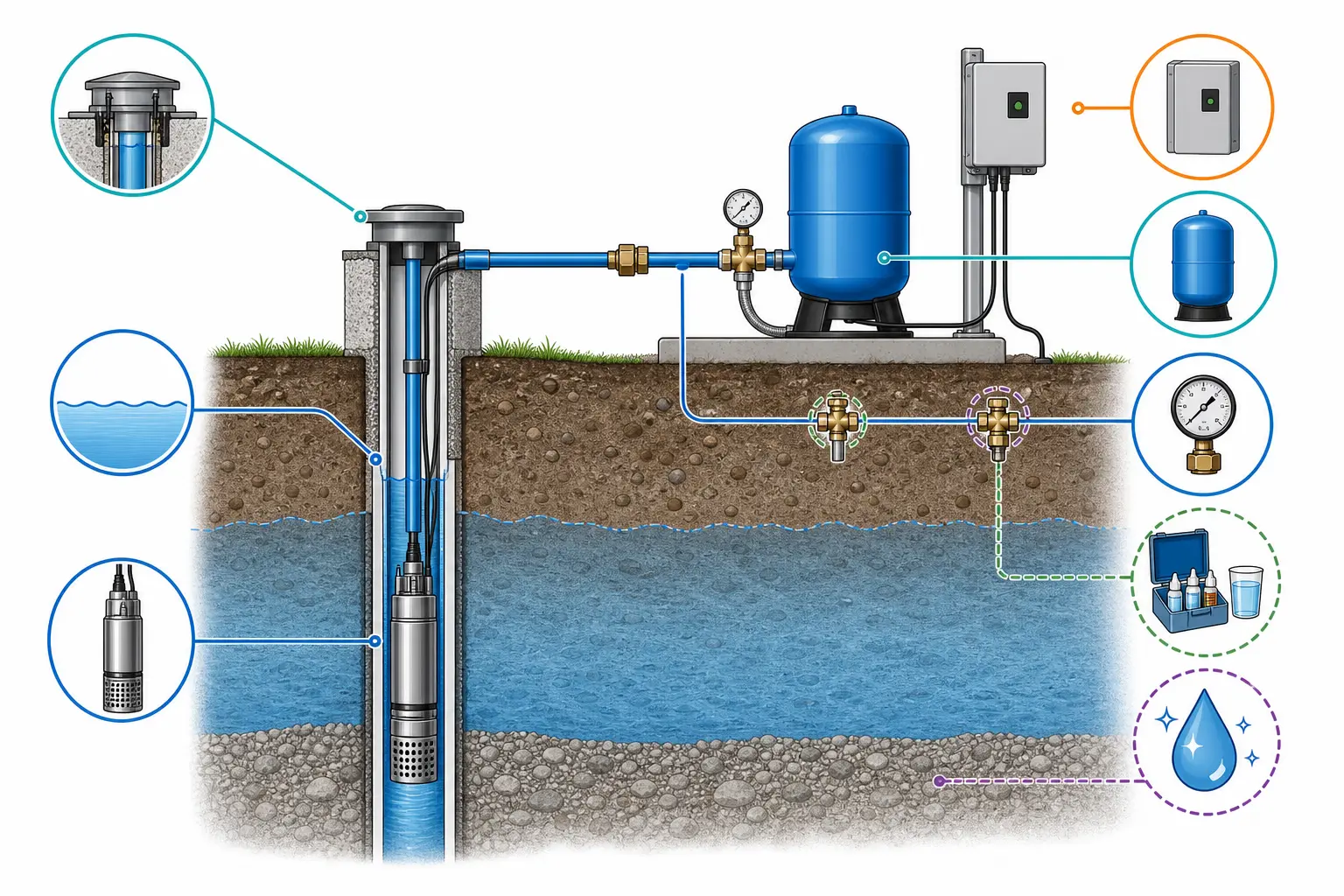
Which compliance items should be checked before quoting?
Create a jurisdiction checklist. At minimum, ask:
- Does the work require a well, pump, plumbing, or electrical license?
- Does breaking the well seal trigger a permit, inspection, disinfection, or record?
- Is a water sample required by the customer, lender, health department, or local authority?
- Who may collect and submit the sample?
- Is a certified laboratory required?
- Does the job involve an electrical scope that must be performed by another licensed trade?
- Does the company need a permit allowance or a confirmed fee before approval?
- Are there disposal, abandonment, or reporting requirements?
NGWA's paper is dated and says at least 26 states separately license or register pump-installation contractors. Treat that as a reason to verify the local rule, not as a current legal conclusion for every state.
Never copy a permit cost from another state into your price book. Put the actual fee, inspection, lab, and administration cost into the job when verified, and use an allowance or approval condition when it is not yet known.
When should water testing be a separate line?
Make testing a separate line when the test has its own laboratory fee, turnaround, collection requirement, or customer approval. A separate line prevents the customer from assuming that “pump repair” includes every possible water-quality test.
Include the applicable sample, lab, courier, disinfection, and return-work assumptions. Do not promise that a pump repair will make water safe if the water-quality cause is unknown. A pump problem and a water-quality problem can overlap, but they are not automatically the same scope.
How do you build a pump repair price book from completed jobs?
Build the price book from actual production records, not from a competitor's website or a homeowner cost guide.
Start with repair classes, then add the fields that explain why the job moved above or below the class expectation.
| Price-book field | Estimate entry | Closeout entry | Why it matters |
|---|---|---|---|
| Repair class | Diagnostic, surface, pull, replacement, emergency | Final class | Shows which prices can be standardized |
| Failure | Suspected condition | Confirmed condition | Measures diagnostic accuracy |
| Access | Documented assumption | Actual condition | Explains labor variance |
| Depth and equipment | Known or unknown | Actual depth, rig, truck, crew | Explains pull and mobilization variance |
| Labor | Planned crew and hours | Paid, on-site, and billable hours | Calibrates production time |
| Travel | Zone, miles, or included radius | Actual truck time and distance | Tests territory policy |
| Parts | Expected component and cost | Actual landed cost, returns, freight | Tests part policy and procurement risk |
| Testing and compliance | Expected tests, permits, disinfection | Actual fees and time | Prevents invisible scope |
| Warranty | Stated coverage | Returns, callbacks, unpaid labor | Prices future exposure |
| Commercial outcome | Quoted, approved, declined | Collected, gross contribution, reason lost | Connects price to business reality |
What should you measure after every job?
Review five comparisons:
- Estimated versus actual labor hours.
- Estimated versus actual travel and equipment use.
- Estimated versus actual parts and consumables.
- Approved scope versus completed scope.
- Quoted price versus collected revenue and gross contribution.
Then record the reason for the variance. “Ran long” is not a reason. “Pump depth was not documented and the pull required a second crew member” is a reason. “Control box was included in the diagnosis but not the quote” is a reason. The reason tells you whether to change the price, the intake form, the scope checklist, or the technician's production method.
Do not revise a price after one unusual job. A single failure can be an outlier, a bad intake, a supplier delay, a weather event, or a legitimate scope change. Look for a repeated pattern by repair class and territory.
How should price-book changes be approved?
Put one person in charge of price-book changes. Require the change to state:
- the repair class affected;
- the evidence from completed jobs or supplier changes;
- the formula or cost cell changed;
- the effective date;
- the customer-facing description;
- the warranty or exclusion impact;
- the estimator and dispatcher training needed.
Archive old versions. If the owner cannot tell which price card was active when a quote was approved, disputes and margin analysis become difficult.
What pricing mistakes reduce profit or trust?
The most expensive mistakes are often policy mistakes, not arithmetic mistakes.
Pricing the part instead of the job
A pump, motor, tank, switch, or control box is one input. The customer is buying diagnosis, safe installation, system testing, access, documentation, and a result under a warranty policy. A parts-only comparison makes your work look expensive because the quote does not explain the work.
Using one labor rate for every call
The same rate may not recover a surface diagnostic, a two-person pump pull, an emergency visit, a commercial standby request, and a warranty return. Use a crew and service class model when the cost structure changes.
Hiding the minimum charge
If the first block of time, dispatch, truck, or diagnosis is part of the service price, say so. Surprises create price objections that a clear policy could have prevented.
Giving a flat price before the failure is known
A symptom is not a diagnosis. If the contractor guesses wrong, the company either absorbs the added work or creates a change-order dispute. Price the diagnostic phase or use a not-to-exceed authorization.
Treating travel as free
A rural service territory is not free to serve. If travel is included in the service minimum, make sure the minimum was built with actual territory and production data. If travel is separate, use a consistent rule.
Marking up the same cost twice
An estimator can accidentally mark up a part, then apply a margin to a subtotal that already contains the marked-up part. Keep cost, markup, margin, and selling price in separate cells.
Forgetting the return visit
Special-order parts, lab results, permits, customer approvals, and failed first repairs can create a second visit. If the price policy says the first visit includes only diagnosis, say what the next visit will require.
Promising a warranty without pricing it
A longer labor warranty, free return travel, or broad system guarantee has a cost. State what is covered and measure callbacks before offering a stronger promise.
Adding more leads before the repair process is ready
More demand does not fix weak diagnosis, unclear quotes, missed calls, or an owner who cannot tell which jobs were profitable. Brictale's well drilling estimate follow-up sequence covers what happens after the quote, while the well drilling call tracking checklist covers the path from call source to booked job. Pricing should connect to both.
The cheapest quote is not the lowest price if it creates a second unpaid visit.
How should you price common repair scenarios?
Use the scenario to choose the method, then populate the actual cost cells from your books.
Scenario 1: A known pressure-switch repair
The intake identifies an accessible pressure switch, the technician knows the system type, the company stocks the likely part, and the repair has a stable production time.
Possible structure:
- defined diagnostic or service minimum;
- flat repair price for the switch and standard installation;
- ordinary consumables and pressure verification;
- stated exclusion for a failed pump, tank, wiring, or unrelated leak;
- documented labor warranty.
This is a candidate for a flat-rate card if completed-job data supports repeatability. It is not a reason to promise that every no-water call is a pressure-switch repair.
Scenario 2: No water and an unknown submersible pump
The caller has no water, the pump setting depth is unknown, the well record is missing, and the control box or pressure system may be involved.
Possible structure:
- diagnostic visit with a defined test scope;
- access and pull decision after inspection;
- separate equipment and crew basis;
- time and materials or not-to-exceed authorization for the pull;
- written repair or replacement estimate after the condition is known;
- testing and disinfection scope when applicable.
This is a poor candidate for a single flat rate quoted from the phone.
Scenario 3: A planned pump replacement with records
The company has the well record, pump setting, model, voltage, drop-pipe information, access, and customer approval for replacement. The company can specify the component and the work.
Possible structure:
- written estimate with a defined replacement scope;
- equipment and crew assumptions;
- parts, removal, installation, fittings, cable, testing, and cleanup;
- permit, inspection, disinfection, and water-quality assumptions;
- alternates for a different pump, damaged cable, or changed field condition;
- parts and labor warranty.
This may support a flat project price, but only because the scope is documented. The price is not flat because pump replacements are always predictable.
Scenario 4: An after-hours loss of water
The customer needs immediate attention, but the company may not have the part or capacity to complete the full repair.
Possible structure:
- emergency dispatch and diagnostic policy;
- defined after-hours crew and labor basis;
- stabilization or temporary restoration scope;
- parts procurement and return-visit rule;
- customer approval limit;
- separate scheduled repair estimate if the emergency visit cannot finish the work.
Emergency pricing should not promise a same-night replacement unless the truck, crew, part, equipment, and approval are actually available.
When should you decline, defer, or re-scope a repair?
Decline or defer a job when you cannot price it responsibly, cannot perform it within your license and equipment, or cannot deliver the promised response without damaging a more important commitment.
Re-scope the call when:
- the customer wants a price without permitting diagnosis;
- the access information is materially incomplete;
- the job requires a license or trade you do not hold;
- the well or pump condition creates a safety risk;
- the required equipment is unavailable;
- the customer refuses the diagnostic or authorization policy;
- the territory cost exceeds what the customer accepts;
- your crew is already at capacity and the emergency promise would be false;
- the work is warranty or prior-work related and the responsible party is unclear.
Do not use a low price to win a job you cannot staff. A bad-fit repair creates the worst kind of lead: it consumes the schedule, produces a dispute, and leaves no useful margin.
When should you stop adding pump-repair demand?
Stop or slow demand generation when calls are being missed, diagnostics are not being closed, estimates are not being followed up, parts are backordered, or crews cannot complete the work at the promised standard.
This is where pricing meets marketing. A page that brings more pump-repair calls can be useful only if the company can answer, qualify, price, schedule, and track them. Brictale's well pump marketing guide covers the demand side. The price card in this article gives the operating side something concrete to improve before buying more attention.
What should you do on Monday morning?
Create the first version of the Pump Repair Price Card in a spreadsheet or job-management system. Do not wait for perfect accounting data.
- List your repair classes: diagnostic, known surface repair, surface system repair, submersible access or pull, replacement, emergency, and warranty.
- Add the loaded labor cost and realistic billable-hour calculation for each crew type.
- Add the normal service-area policy and a separate rule for remote or special-equipment calls.
- List parts and consumables by repair class, with supplier source, freight, return, and warranty fields.
- Add risk flags for unknown diagnosis, depth, access, crew, equipment, emergency timing, testing, and permit requirements.
- Choose the allowed pricing model for each class: diagnostic, flat rate, T&M, not-to-exceed, or written estimate.
- Write the quote inclusions, exclusions, approval limit, warranty, and change-order language.
- Train the person answering the phone to collect the intake fields without diagnosing beyond the evidence.
- Train the technician to record the confirmed failure, actual time, equipment, parts, tests, and return needs.
- Review the first completed jobs by class and change one verified weak point at a time.
Use the worksheet below as the minimum record.
| Field | Your entry |
|---|---|
| Repair class | |
| Diagnostic or service scope | |
| Loaded crew rate | |
| Minimum charge policy | |
| Travel or territory rule | |
| Equipment or rig rule | |
| Parts handling policy | |
| Testing, disinfection, or permit rule | |
| Risk flags | |
| Allowed price model | |
| Authorization limit | |
| Warranty policy | |
| Actual-versus-estimate review date |
If the company cannot fill a field, that is useful information. It tells you where the next call, estimate, job closeout, or accounting record needs better data.
What is the practical verdict on well pump repair pricing?
Price the job you can document, not the job the caller guessed.
Build the cost floor from loaded labor, travel, equipment, parts, compliance, warranty, and overhead. Match the price model to certainty. Use flat rate for repeatable scopes, time and materials for variable work, and a not-to-exceed or staged authorization when the failure or access is unknown. Write the exclusions before the customer has to ask for them. Then compare every estimate with the completed job.
The result is not a universal number. It is a pricing system that tells you when a number is safe to promise and when it is not.
If your company can see pump-repair demand but cannot tell which calls, estimates, or service areas produce profitable booked work, Brictale's free territory audit can identify the visibility, intake, tracking, and service-page gaps worth fixing first.