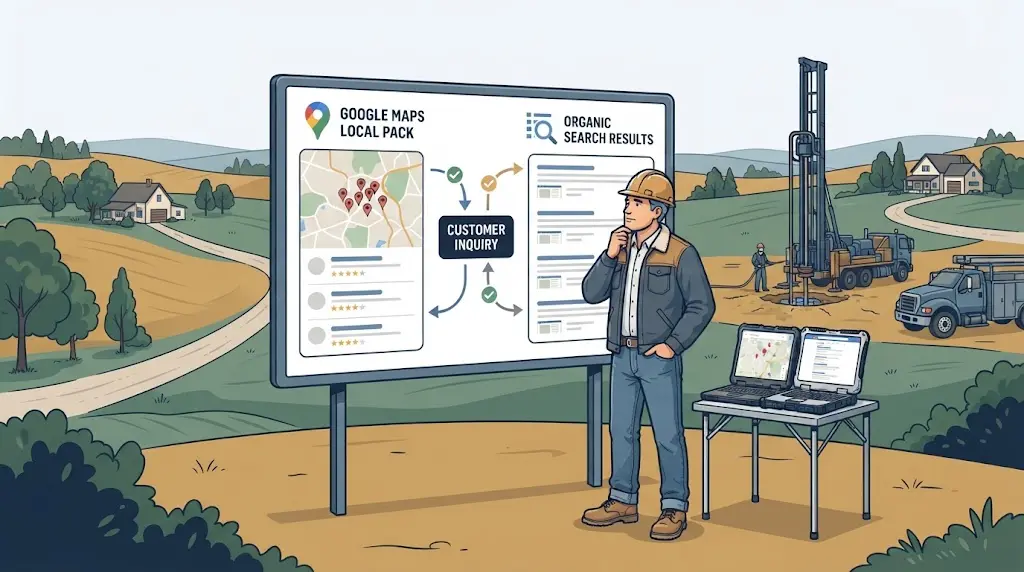
Google Maps and organic SEO can both produce customers for a well drilling or pump company. They do not do the same job, and they do not fail for the same reasons.
Maps is the local entry point. Organic SEO is the deeper explanation and proof layer. The right first move depends on the work you want, the territory you can serve, the urgency of the call, and whether your office can turn demand into booked jobs.
What does Google Maps versus organic SEO actually compare?
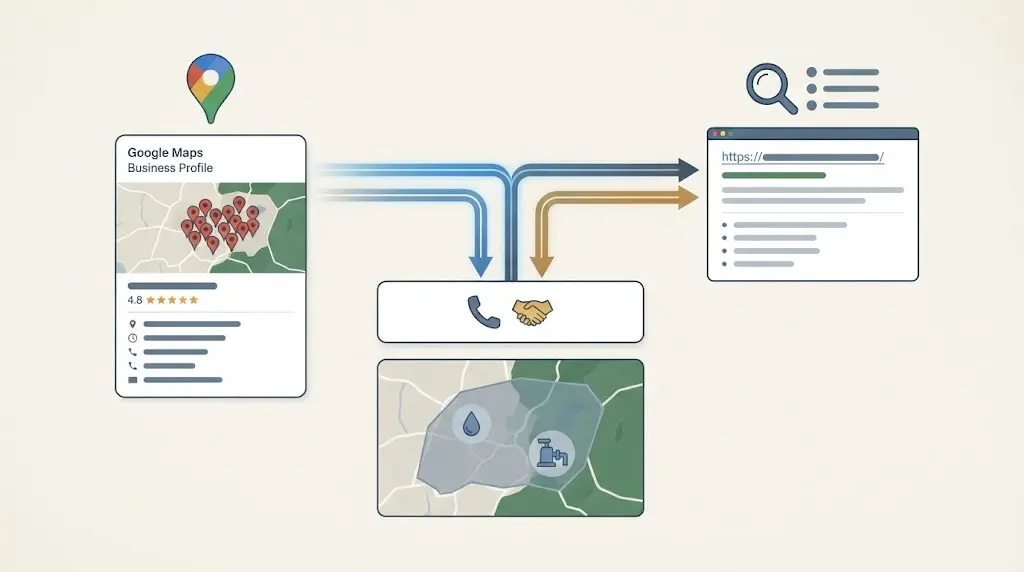
Google Maps visibility comes mainly through your Google Business Profile and the local results shown in Maps and Google Search. Organic SEO is the work that helps your website appear in the regular search results for service, problem, territory, and research queries.
They can appear on the same results page, but a contractor should treat them as two different surfaces with one connected customer path.
| Decision point | Google Maps and Business Profile | Organic SEO and website |
|---|---|---|
| Main job | Help nearby searchers find, trust, and contact the company quickly | Explain a service or problem in enough depth for a buyer to choose a company |
| Core asset | Verified Business Profile | Crawlable, useful website |
| Strongest fit | “well pump repair near me,” “well driller near [town],” urgent local need | “commercial well drilling,” “replace submersible pump,” “well rehabilitation,” service and territory research |
| Important constraints | Relevance, distance, prominence, real operating base, accurate service area | Page quality, crawlability, relevance, useful structure, evidence, links, and time |
| Typical conversion path | Profile view, call, message, website tap, directions | Search result, service page, call, form, qualification, estimate |
| Common mistake | Treating the profile like a list of every city or service | Publishing thin pages that name a town but do not help a buyer decide |
| What it cannot do alone | Explain every service boundary, project type, or qualification detail | Put a call button and local profile in front of every nearby searcher |
“Local results are mainly based on relevance, distance, and popularity.”
Source: Google Business Profile Help, “Tips to improve your local ranking on Google”
Google's own local-ranking guidance explains relevance as the match between a Business Profile and the search, distance as how far the business is from the searcher, and prominence as how well-known the business is, with information such as links and reviews contributing to that picture.
Organic search is not just a place to add keywords. Google describes SEO as helping search engines understand a site and helping users decide whether to visit. Its starter guide also says useful, unique, current, people-first content matters and that there is no magic word-count target. Google's SEO Starter Guide explains the organic layer.
The practical comparison is not “which channel is universally better?” It is “which layer is currently blocking profitable demand, and what does the next work package need to fix?”
Maps is the local entry point; organic SEO is the explanation layer.
Which channel should a well contractor prioritize first?
Prioritize Maps when the business needs nearby calls soon and the profile, service area, reviews, or contact path are weak. Prioritize organic SEO when the buyer needs to understand a complex service and the website cannot answer the questions that stand between interest and a call. Start with both foundations when either surface would otherwise send the other one bad or incomplete information.
That answer sounds simple. The hard part is identifying the real situation rather than picking the channel an agency happens to sell.
Use this contractor-side scorecard. It is a decision aid, not a market benchmark. Give each item a score from 0 to 2:
- 0 means the condition is absent or not ready.
- 1 means it exists but is inconsistent.
- 2 means it is strong and can support more demand.
Maps priority score
Add points for:
- The company wants urgent pump, pressure tank, or no-water calls.
- Customers choose a provider largely by distance and call convenience.
- The Business Profile is incomplete, inaccurate, unverified, or poorly categorized.
- The company has real customer reviews and can request them honestly after completed work.
- The profile and phone process can handle more calls during operating hours.
Organic priority score
Add points for:
- The company wants more complex drilling, commercial, agricultural, testing, rehabilitation, or replacement work.
- Buyers need to compare process, service limits, project types, or qualifications before calling.
- The site has no dedicated page for an important service or has only a generic homepage.
- The territory is broad enough that one profile cannot explain all real service and project coverage.
- The company can publish or supply accurate technical detail, project proof, and clear qualification guidance.
The point totals do not predict calls. They force a useful conversation. If Maps has more points, make the profile and call path the first work package. If organic has more points, improve the pages that match the profitable services. If both scores are high, do not choose one out of habit. Build the handoff between them.
What does the scorecard look like in common contractor situations?
| Contractor situation | First priority | Why | What must still exist in the background |
|---|---|---|---|
| Pump repair and pressure-system work with a real local base | Maps foundation | The customer may need a nearby provider and a fast phone response | A pump repair page that confirms service boundaries and next steps |
| New residential well drilling in a wide rural territory | Both foundations, then organic weight | The service is local but the decision can require more trust and explanation | An accurate profile, honest territory, and pages for drilling and qualification |
| Commercial or agricultural drilling | Organic weight with Maps accuracy | The buyer may search by project type, capability, and geography rather than only “near me” | A profile that matches the real business and sends prospects to the right site page |
| A good website but an unclaimed or inaccurate profile | Maps foundation | The local entry point is broken even if the site is strong | A clear service page so a profile visitor has somewhere useful to go |
| Strong profile visibility but no pages for pump replacement or rehabilitation | Organic service-page work | Maps can create attention but the site cannot answer the service question | Profile details that accurately reflect the services actually offered |
| Referral-led company at full capacity | Neither growth channel first | More demand is not the constraint | Intake, capacity, margin, and service-territory decisions |
| Company with no reliable call answering or disposition | Operations first | Visibility cannot be measured or served well | A functioning phone, intake, and job-status process |
This is the core decision: pick the channel that fixes the bottleneck, not the channel with the more impressive dashboard.
What does Google Maps do well for a well and pump company?
Maps does three jobs especially well: it makes the company findable in a local context, it gives a searcher a fast way to judge basic trust, and it offers a direct path to call or visit the website. It is most useful when the searcher already knows the kind of provider needed and wants a realistic option nearby.
It gives local context immediately
A profile can show the business name, category, phone, website, hours, service area, photos, services, and reviews. Google says complete and accurate information helps businesses show up for relevant local searches, and it recommends keeping profile details current. Google's local ranking guidance covers complete profile information.
For a contractor, the local context matters because the searcher wants to know more than whether a web page contains the phrase “well drilling.” They want to know whether the company is real, reachable, open, nearby enough to respond, and likely to perform the work.
It supports urgent call behavior
The profile can be the shortest route from a local search to a phone call. That can matter for a pump failure, no-water issue, pressure switch problem, or other job where the owner or property manager is trying to speak with someone rather than read ten pages.
But a short path is only valuable if the office can use it. A missed call, an unanswered call that is never returned, or a call to a company that does not perform the requested service is not a qualified lead. It is a visibility event with no business value yet.
It makes reviews and proof visible at the decision point
Reviews can help a prospect decide which profile to open or call. Photos can show real equipment, crews, pump rooms, drilling work, service vehicles, or completed project conditions. They should represent the actual company. They should not be stock photos presented as field work or generic images that promise services the crew does not perform.
Google says reviews and positive ratings can help a business's local ranking by contributing to prominence, while review replies help a business stand out. The official local ranking guidance describes reviews and prominence.
That is a platform statement, not a promise that acquiring reviews will put a contractor in the top three. Local visibility still varies by searcher location, relevance, and the rest of Google's system.
It can surface the service area, within real limits
Well and pump companies often travel. That creates a harder Maps problem than a storefront with a compact neighborhood.
Google's service-area guidance says a service-area business can have one profile for the whole area it serves. It allows up to 20 service areas, says the areas should be specific and accurate, and says the overall boundaries generally should not extend more than about two hours of driving time from the business base. It does not let a business define an editable service area as a simple radius. Google explains service-area profiles and their limits.
This matters for the contractor decision. If your profitable drilling territory extends beyond what is sensible for one profile, the answer is not to create a profile for every county. The answer may be clearer organic coverage, a narrower Maps service area, a real second location with its own staff and operations, or a business decision to stop pursuing distant work.
A service area is not a substitute for a real operating base.
What Maps does not solve by itself
Maps is not a complete marketing system. A profile cannot fully explain:
- the difference between well drilling, pump installation, pump repair, replacement, and rehabilitation;
- what a commercial or agricultural buyer should prepare before asking for a quote;
- which counties are profitable for a particular crew and equipment setup;
- what testing, inspection, access, permitting, or site information may be needed;
- what a project process looks like after the first call;
- whether the company has the capacity for another job this month; or
- why a prospect should trust the company when several providers appear nearby.
Those questions belong on the website, in the call process, or in both.
What does organic SEO do well for a well contractor?
Organic SEO gives the company a set of pages that can match specific service and problem searches, explain the work before the call, and continue working outside the immediate radius of the Business Profile. It is a better first investment when the work is complex, the territory is broad, or the buyer must gather information before contacting a provider.
It can match the service a buyer actually wants
A homepage that says “water well services” may be accurate but still too broad. A buyer looking for commercial well drilling, a replacement submersible pump, a pressure tank issue, or well rehabilitation needs a page that names the service and explains what the company actually does.
Organic pages can carry distinctions that a profile cannot carry in enough depth. A useful service page should make clear:
- What the service is.
- Which customer or project types it fits.
- What the company does and does not handle.
- Which territory the crew can serve.
- What information the office needs to qualify the request.
- What the next step is.
This is why organic SEO can be valuable even when Maps produces the first call. The profile can introduce the company, and the page can make the call better informed.
It can support larger or less urgent decisions
A new well, commercial groundwater project, agricultural installation, pump replacement, or rehabilitation job can carry more questions than “are you open?” The searcher may compare services, geography, experience, process, evidence, and the right contact path.
Organic SEO does not guarantee that a buyer will read the entire site. It gives the buyer a place to resolve important uncertainty. The page earns its place when it prevents another search for basic answers or reduces the number of unqualified calls the office has to handle.
It can cover real territory without creating fake locations
Maps has a business-profile constraint tied to the real operating base. The website can explain legitimate territory coverage in a way that serves the buyer. That does not mean duplicating the same city page hundreds of times. It means building pages around real services, real operating zones, and real proof.
A good territory page might explain the counties or regions served, travel boundaries, the services available there, and the information needed to determine fit. If two regions have different crews, capabilities, project types, or proof, separate pages may make sense. If the only difference is the town name, a page-per-town program is likely padding.
Google's Search Central guidance warns against creating content primarily for search engines and recommends unique, helpful, reliable, people-first information. Google's helpful-content guidance explains the people-first test.
It creates a durable explanation asset
The website is the contractor's owned explanation layer. An agency can help improve it, but the company should retain control of its domain, content, analytics, tracking, and Business Profile access. Organic progress can be monitored in Search Console through clicks, impressions, CTR, and average position by query and page. Google documents the Search Console performance metrics.
That makes organic SEO useful for learning. If the site earns impressions for “well pump replacement” but no clicks, the page title or result framing may be weak. If it earns clicks but no calls, the page or offer may not answer the buyer's next question. If the right service pages never gain impressions, the problem may be relevance, crawlability, authority, or an unrealistic query choice.
What organic SEO does not solve by itself
Organic SEO cannot compensate for:
- a profile that sends local customers to a dead number;
- an office that cannot answer or return calls;
- a company that accepts work outside its profitable service territory;
- unclear service boundaries;
- poor intake information;
- no proof that the website describes the real company; or
- a field operation that cannot take on additional jobs.
It can create a better demand path. It cannot make the operation ready for demand.
Does a strong Maps profile make organic SEO unnecessary?
No. A strong profile can produce attention and calls, but it does not replace service pages, technical explanation, project proof, or the website conversion path. For a well contractor, the most useful setup is a handoff from local visibility to specific evidence and qualification.
Think of the path as:
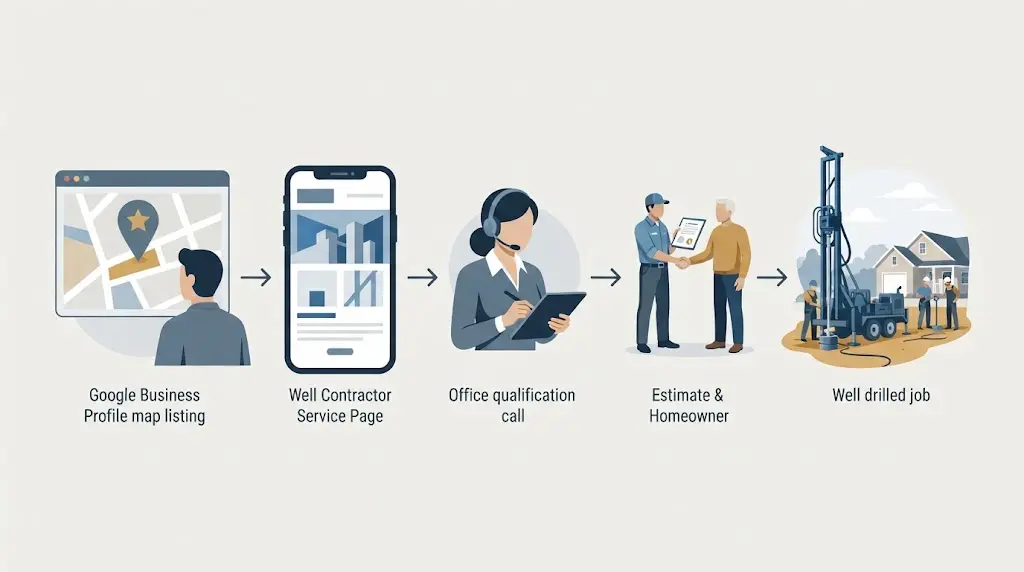
Profile discovery -> profile trust check -> website or call -> service qualification -> estimate -> booked job -> closed work
Not every customer follows every step. A pump repair prospect may call straight from Maps. A commercial buyer may visit several pages and submit a form. A drilling prospect may call after reading one service page and a project explanation. The path is still useful because it identifies where measurement can break.
What should the profile and website agree on?
They should agree on the facts that make the company recognizable and reachable:
- company name and authoritative phone number;
- real operating base and legitimate service area;
- primary services and accurate categories;
- hours or response expectations;
- website destination;
- service descriptions;
- photos and proof that represent the actual company; and
- the types of work the office is willing to qualify.
The profile should not promise every groundwater service if the company only performs pump repair. The website should not say “all counties” if the crew declines distant jobs. A mismatch creates both ranking noise and poor calls.
What should the website do after a Maps click?
The landing page should answer the searcher's next question without forcing them to hunt. For a pump repair query, show the relevant service, the territory, the contact path, and what information helps the office respond. For drilling, explain the project type, territory, and next steps. For commercial or agricultural work, make the capability and inquiry process easy to find.
A visitor who clicks from Maps should not land on a generic page with a long list of unrelated services and no obvious phone or request path. The profile earned the visit. The website should earn the call.
Why can a well contractor rank in Maps but not in organic search?
A contractor can have local profile visibility while the website lacks pages, structure, or relevance for the services people search. Maps and organic search are connected, but a good showing in one does not automatically produce a good showing in the other.
Use the diagnosis below before buying more work.
| What you observe | Likely bottleneck | First check | Best next action |
|---|---|---|---|
| Profile appears for nearby searches, website does not | Weak service-page coverage, crawlability, or organic relevance | Search Console pages and queries; inspect service pages | Build or improve the highest-value service page and link it from the profile and site |
| Website ranks for a service, profile is absent or wrong | Profile eligibility, ownership, category, service area, or local prominence | Verify profile ownership and inspect local information | Repair the real profile and its facts before adding more content |
| Both appear, calls are low | Weak trust, unclear CTA, wrong search match, or poor phone response | Open the result as a prospect; review call logs | Improve proof, message match, and call handling before chasing rankings |
| Calls are high, qualified calls are low | Broad service language, territory mismatch, or poor lead screening | Sample calls and classify service, location, and fit | Narrow the message and add qualification guidance |
| Qualified calls are high, booked jobs are low | Estimate process, capacity, pricing fit, or follow-up | Compare office disposition with CRM/job records | Fix sales and operations; do not automatically buy more visibility |
| Neither surface appears for the target service | Wrong query, missing entity information, weak page, or real local constraint | Run a fixed query sample and inspect the business facts | Choose one service and one territory, then fix foundations before scaling |
This matrix prevents a common waste pattern: treating every visibility problem as a request for more content or every call problem as a request for more reviews.
How can you audit your Maps and organic visibility in one working session?
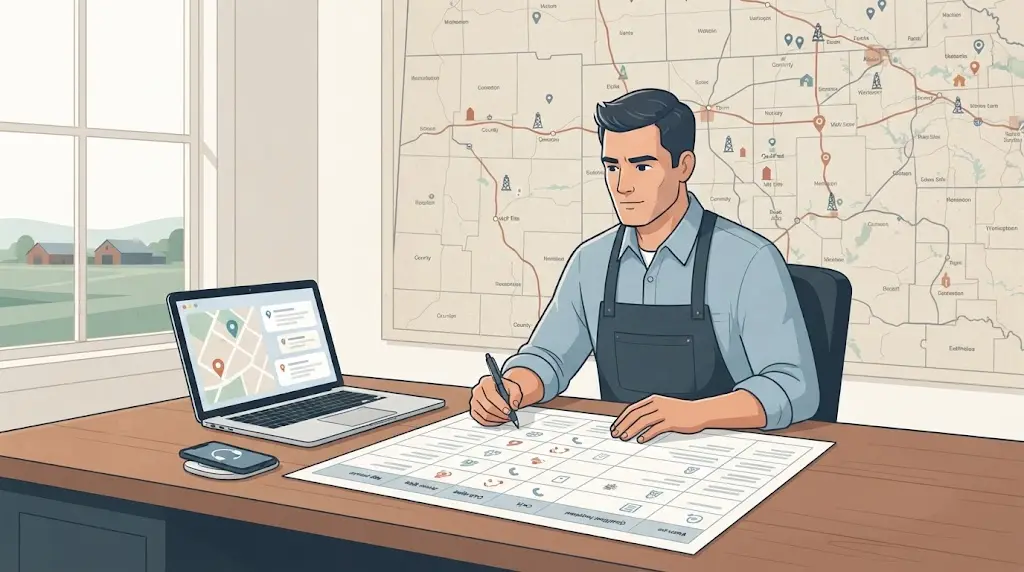
Run a repeatable audit using the services and territories that matter to the business. Do not search only for your company name. Brand searches mostly tell you whether Google knows the brand, not whether a new customer can find it.
Step 1: Choose a small query set
Choose five to ten query families. Include the service words the company wants, not every service it has ever performed. A starting set might include:
- well drilling near [base town];
- residential well drilling [county or region];
- commercial well drilling [region];
- agricultural well drilling [region];
- well pump repair [base town];
- well pump replacement [region];
- pressure tank repair [region];
- well rehabilitation [region]; and
- the most important non-brand problem query from the phone log.
Use the same query set every month. If the set changes every time, the trend becomes a story instead of a measurement.
Step 2: Separate local and organic observations
For each query, record:
- Whether a local pack or Maps result appears.
- Whether the business profile appears and how far the searcher location is from the base.
- Whether the company website appears in the organic results.
- Which page appears.
- Whether the result matches the service requested.
- What the next action is: call, website, directions, message, or no obvious path.
Local results vary by searcher location and personalization. The goal is not to create a universal ranking claim from one screen. The goal is to compare the same questions, locations, and conditions over time and identify gaps.
Step 3: Check the profile against the operation
Verify the business name, primary category, phone, website, hours, photos, services, review responses, and service area. Ask a blunt question: if a new customer called from this profile, would the office accept the job, qualify it, and know what to do next?
If the company is a service-area business, check whether the profile represents one real operating base rather than a collection of invented locations. Google says service-area businesses can have one profile for the whole area they serve, and its representation guidelines say a virtual office that does not represent a real operating location is not eligible. Google's ownership and representation guidance sets these boundaries.
Step 4: Check the website as a buyer
Open the page that ranks for each service. In less than a minute, answer:
- Do I know whether this company performs the exact service?
- Do I know the territory and whether my site is plausible?
- Do I see proof that relates to this kind of work?
- Do I know what information to provide?
- Can I call without searching for the number?
- Is the next step clear on a phone?
If the answer is no, more impressions will not fix the page.
Step 5: Compare visibility with office outcomes
Take a sample of recent inquiries. Classify every contact as:
- wrong number or spam;
- homeowner or business inquiry, if that distinction matters to the service;
- outside territory;
- service not offered;
- potentially qualified;
- estimate requested;
- estimate delivered;
- booked;
- completed or closed; or
- lost for a known reason.
The labels should fit the company's real process. The point is to create a shared language between marketing, office staff, and operations.
Step 6: Choose one bottleneck to fix
Do not turn the audit into a list of 40 tasks. Choose the bottleneck that can change the next customer path. Examples:
- profile is wrong -> repair ownership and facts;
- profile is accurate but service page is generic -> build the page;
- page gets calls but the office cannot qualify them -> repair intake;
- page gets qualified calls but no estimates are booked -> repair follow-up;
- territory is too broad for profitable service -> narrow the offer and coverage;
- no data exists -> install source and disposition tracking before judging the channel.
When should Google Maps come first?
Maps should come first when the contractor's next profitable job is local, call-led, and dependent on a nearby searcher finding a trustworthy provider quickly. “First” means the first focused work package, not permission to ignore the website.
Maps-first situation 1: The profile is not ready to represent the company
If the profile is unverified, owned by an agency, tied to an outdated number, missing the website, or describing the wrong service, repair that before trying to improve visibility. A profile with incorrect facts is not a marketing asset. It is a source of bad expectations.
Google's Business Profile ownership guidance says only owners or authorized representatives should verify and manage a profile. It also says representatives should work with owner consent, keep the owner informed, and encourage the owner to own the profile while granting managers access. Google explains Business Profile ownership and authorized representatives.
The owner should have access to the Google account, the profile, the website, analytics, call records, and any agency work product. This is basic continuity, not a distrust of marketing providers.
Maps-first situation 2: The company wants pump calls in a compact territory
If the company performs pump repair, pressure-system work, or replacement within a manageable local area, a strong profile foundation can be the most direct route to being considered by nearby searchers. The office still needs a service page and intake process, but the local entry point is a sensible first focus.
Do not turn “nearby” into “everywhere.” The farther the service area extends, the more distance matters. A company can choose to travel farther for a high-value drilling project than for a small repair, but that commercial decision belongs in the service offer and the website. It does not require pretending the profile has an office in every place served.
Maps-first situation 3: The company has strong service proof but poor local presentation
Some contractors have real field experience, good photos, and satisfied customers but an incomplete profile. In that case, the work is not inventing proof. It is presenting truthful proof in the local surface where a searcher is already comparing providers.
The proof should be specific enough to be useful: what work was performed, what type of equipment or system was involved, what territory the job was in, and what the company actually delivered. Do not disclose private customer information or imply a result that the public review does not support.
What should a Maps-first package include?
Keep it small enough to audit:
- Confirm owner access and eligibility.
- Correct the core business facts.
- Set accurate categories, services, hours, phone, website, and service areas.
- Add real photos and respond to reviews without scripts that sound false.
- Build or repair the most relevant service page.
- Test the phone path and office disposition.
- Record a fixed local query sample and a baseline of calls and qualified calls.
That package is enough to identify whether Maps is a real bottleneck. It is not a promise of a top-three position.
When should organic SEO come first?
Organic SEO should carry more early weight when the company sells services that require explanation, when the territory is broad, when buyers search by project type, or when the website is too thin to turn a profile visit into a confident inquiry.
Organic-first situation 1: The profitable service has no useful page
If the business wants more commercial drilling, agricultural work, rehabilitation, inspection, testing, or pump replacement but the website only has a homepage, organic service-page work is not optional polish. It is the information layer the buyer needs.
The page should not be written as a generic article about the service. It should operate as a decision page for a buyer: who it is for, what the company handles, where it works, what the initial conversation covers, and how to make contact.
Organic-first situation 2: A profile visitor needs technical context
Well work can involve access, site conditions, equipment, water needs, property type, existing system details, and project scope. The website can organize those questions so the office receives a better first conversation.
The page does not need to publish a one-size-fits-all technical prescription. It should help the buyer describe the job accurately and understand what the company will need to learn. That supports qualification without pretending that a web page can replace a site assessment or contractor judgment.
Organic-first situation 3: The company needs to reach real service zones outside the profile's core area
A service-area profile cannot be stretched indefinitely. The website can explain legitimate regional coverage and service differences, provided the pages contain useful information rather than a town name swap.
Use a regional page when there is a real business reason: a separate crew, a distinct service mix, an important project type, local proof, or meaningful customer questions. A page that changes only the town name is not a territory strategy.
Organic-first situation 4: Search Console shows impressions but the wrong page ranks
If queries related to pump replacement, drilling, or testing are generating impressions for the homepage or an unrelated blog post, the site may have a page-to-intent problem. The next move is not automatically more backlinks or more town pages. First create the page that should answer the query, then link it from relevant site pages and the profile where appropriate.
Google's Search Console data can be segmented by query and page. That lets an owner see whether the right service page is earning impressions and clicks, rather than treating all organic traffic as one bucket. Google documents query and page analysis in Search Console.
What should an organic-first package include?
- Choose one profitable service and one realistic territory.
- Interview the office or field lead for the real service boundaries and common qualification questions.
- Build a page that answers the buyer's service and next-step questions.
- Make the phone and form path visible on mobile.
- Link the page from the homepage, relevant service pages, and profile website destination where it is the best match.
- Inspect indexing and Search Console data.
- Record calls and job outcomes separately from impressions and clicks.
This builds a useful organic asset without pretending that publication date equals a result date.
How should service mix change the Maps and SEO decision?
Service mix should determine both the first channel and the page architecture. A contractor who treats every call as “well service” will make the profile and website less useful to customers and the office.
| Service line | Searcher state | Maps role | Organic role | Qualification detail to make clear |
|---|---|---|---|---|
| Pump repair | Often urgent and local | Fast discovery, call, hours, reviews, service area | Explain symptoms handled, response process, and limits | System type, location, issue, urgency, and territory |
| Pump replacement | Local but more considered | Trust and contact path | Explain replacement context, options at a high level, and next step | Existing pump information, symptoms, access, and property type |
| Pressure tank or switch work | Often specific and call-led | Local relevance and easy phone path | Match the problem phrase to a clear service page | System details and whether the company handles the repair |
| Residential well drilling | Local but high-consequence | Establish legitimate local presence and trust | Explain process, project fit, territory, and what starts an inquiry | Property location, intended use, access, and project stage |
| Commercial well drilling | Research-heavy and capability-led | Confirm the company is real and reachable | Demonstrate project type, capacity, geography, and inquiry process | Intended use, scope, site, timeline, and decision team |
| Agricultural well work | Territory and capability matter | Support local recognition | Explain the service and regional fit without generic claims | Use case, acreage or operation context, site details, and timing |
| Well rehabilitation or inspection | Need and scope vary | Provide trust and a direct contact | Explain when the service may fit and what information is needed | Existing well history, symptoms, records, and requested outcome |
This table is a planning tool. It does not tell the contractor to publish technical advice that the company cannot verify. It tells the marketing owner to put each service in the surface where its buyer's questions can be answered.
The first channel should be the one that fixes the current bottleneck.
What should the first 30, 60, and 90 days look like?
The sequence should create evidence, not just activity. Use 30, 60, and 90 days as review points for work completed and data quality, not as promises that a ranking or job count will arrive on a schedule.
Days 1 to 30: Make the company findable and measurable
The first period is about truth and access.
- Confirm ownership of the Business Profile, domain, analytics, Search Console, phone system, and CRM or job-status records.
- Write down the real operating base, service area, profitable travel limits, service lines, and work the company does not accept.
- Correct the profile's core facts and remove anything inaccurate.
- Check whether the profile is eligible and whether the service-area setup reflects one real business.
- Choose the five to ten query families for the monthly audit.
- Build or repair one highest-value service page.
- Test every phone number, form, and website-to-call path.
- Agree on office disposition labels for qualified call, estimate, booked job, and closed work.
At the end of this period, the owner should be able to answer: what does the company want to be found for, where can it actually work, who owns the assets, and how will the office classify an inquiry?
Days 31 to 60: Improve the handoff
The second period is about match quality.
- Improve the next service page based on the first query and call evidence.
- Align profile services, website language, and office qualification questions.
- Add authentic field photos and useful proof where available.
- Review unanswered, outside-territory, and wrong-service calls.
- Add internal links so service pages are reachable from the site structure.
- Inspect Search Console queries and pages for mismatches.
- Compare Maps visibility and organic visibility using the same query set and search locations.
- Fix the highest-friction conversion problem, such as a hard-to-find phone number or a vague next step.
Do not expand the number of service pages merely to show activity. Expand when the next service has a real buyer, a clear company capability, and enough accurate information to produce a useful page.
Days 61 to 90: Decide what deserves more investment
The third period is about choosing the next constraint.
- Compare the baseline with the new local and organic observations.
- Separate profile actions, website visits, calls, qualified calls, estimates, booked jobs, and closed work.
- Identify which services produce the best fit, not only the most contacts.
- Review whether the territory is profitable at the distance implied by demand.
- Decide whether to add another service page, improve the profile, repair intake, or stop scaling.
- Keep a short record of changes and dates so later performance is interpretable.
The decision at day 90 may be “continue Maps work,” “build organic coverage,” “repair the sales path,” or “do not buy more traffic.” All four can be correct.

How do you measure Maps versus organic SEO all the way to booked jobs?
Measure visibility by channel, but judge the business by qualified demand and work outcomes. Search Console and Business Profile data are useful leading indicators. They do not replace the office record of what happened after contact.
Keep two visibility ledgers
The first ledger is Maps:
- target query and search location;
- profile appeared or did not appear;
- profile views or actions where available;
- calls or messages;
- service and territory fit;
- qualified call;
- estimate;
- booked job; and
- closed or completed work.
The second ledger is organic:
- query;
- landing page;
- impressions;
- clicks;
- CTR;
- average position;
- phone call or form;
- service and territory fit;
- qualified call;
- estimate;
- booked job; and
- closed or completed work.
The top of each ledger is different because a Maps call may happen without a website visit, while an organic visitor may read several pages before calling. The bottom should use the same office and job-status definitions.
What does Google officially measure?
Search Console reports clicks, impressions, CTR, and average position, and lets site owners analyze those by query, page, country, device, and search appearance. That is enough to find organic visibility and page-match problems. It is not enough to know whether a caller was in territory, wanted a service the company performs, received an estimate, or booked work.
Google Ads has a separate phone-call conversion system. Google documents calls from ads, clicks on a phone number on a mobile website after an ad, call-ad and asset clicks, and imported call conversions. It says imported conversions can be limited to calls that include sales and can include sales values when call details and outcomes are tracked in another system. Google's phone-call conversion documentation describes these options.
That capability is most relevant to paid advertising. For organic Maps and organic website work, the same principle still applies: use a call log or CRM disposition as the authority for qualification and job outcome, then connect the source as accurately as the system allows.
What should the weekly scorecard show?
| Layer | Maps example | Organic example | What the number means |
|---|---|---|---|
| Visibility | Profile appeared for a fixed local query | Page earned an impression for a query | The company was eligible to be seen in that sample |
| Engagement | Profile action or call | Organic click or form start | Someone took a next action |
| Contact | Call or message | Call or form submission | A contact occurred, not necessarily a lead |
| Fit | In territory and service offered | In territory and service offered | The contact may be commercially relevant |
| Qualification | Office marked it qualified | Office marked it qualified | The business accepts the opportunity for follow-up |
| Estimate | Estimate requested or delivered | Estimate requested or delivered | The contact progressed into the sales process |
| Booked job | Scheduled or booked | Scheduled or booked | The marketing path contributed to booked work |
| Closed work | Completed or closed value | Completed or closed value | The outcome that should guide future priorities |
Do not collapse these rows into one “lead” number. A raw call can be a wrong number. A qualified call can still be outside capacity. A booked job can still be unprofitable. The definitions should be simple enough that office staff use them consistently.
Raw calls are not qualified demand.
What attribution limits should an owner accept?
Some searches and calls cannot be attributed perfectly. A person may see the profile, remember the name, search the brand later, and call the main number. Another person may click from an organic page, call from a different device, and never appear as a clean session-to-call chain.
The answer is not to pretend the data is exact. Keep source labels, ask the office to record “how did you hear about us?” when practical, use consistent call and form tracking, and compare trends rather than inventing precision. A useful imperfect ledger is better than a polished report that counts every contact as a success.
What mistakes waste the most time or create risk?
The worst mistakes are usually not a missing keyword. They are false location signals, asset-control failures, poor service matching, and reporting that stops before the job outcome.
Mistake 1: Creating fake Maps locations
A service-area contractor may be tempted to create profiles for every major town. Google says a service-area business can have one profile for the whole area it serves, and its representation guidelines say businesses should not create more than one page for each location. A virtual office that does not represent a real operating location is not eligible. Read Google's representation guidelines before changing locations.
Do not use a rented mailbox, a coworking address that is not a real staffed operating location, a keyword-loaded address, or a city where the company does not have a legitimate operation. The short-term appearance of coverage is not worth profile suspension or customer confusion.
Mistake 2: Stuffing the profile name with services or towns
The business name should represent the real-world business, not a list of target phrases. Use accurate categories and service fields. Put the full explanation on the website and in the profile content that Google permits, rather than turning the name into “Best Well Drilling Pump Repair [Every County].”
Mistake 3: Buying or manufacturing reviews
Ask for honest feedback from real customers after completed work. Do not write reviews for customers, offer rewards that distort the review, or publish feedback that was not provided. Authentic review language can help a buyer understand the work. Fake proof creates reputation and platform risk.
Mistake 4: Building a page for every town with the same copy
Organic SEO is not a license to repeat a paragraph and change a place name. If a page does not add local service information, proof, project context, or a real decision aid, it is unlikely to help the buyer. Google explicitly recommends unique, useful, people-first content and warns against content made primarily to attract search-engine visits. Google's people-first guidance states the originality and usefulness test.
Mistake 5: Treating the homepage as every service page
The homepage can introduce the company. It should not force a buyer to reconstruct whether the company performs pump repair, commercial drilling, agricultural work, or rehabilitation. Each important service needs a clear explanation somewhere on the site. Not every service needs a 3,000-word article. It does need a page that answers the buyer's immediate questions.
Mistake 6: Letting the agency own the contractor's assets
An agency can be a manager or authorized representative. It should not be the only owner of the Business Profile, domain, analytics, Search Console, phone system, call data, or published work. Google's ownership guidance says the business owner should understand the profile and its use, and authorized representatives should transfer ownership to the business owner when requested. Google's ownership guidance covers owner and representative responsibilities.
Mistake 7: Reporting rankings as revenue
A rank can move while the phone stays quiet. An impression can increase while the page attracts the wrong service. A call can increase while qualified work decreases. Report the full path and record the uncertainty.
Mistake 8: Promising a guaranteed position or a fixed lead timeline
Google's SEO Starter Guide says, “There are no secrets here that'll automatically rank your site first in Google (sorry!).” Google's guide explains why rankings are not guaranteed.
An honest plan can name the work, evidence, review points, and stop conditions. It cannot honestly guarantee a top-three Maps result, a particular number of calls, or a universal month when organic SEO will pay back.

When should a well contractor invest in neither channel?
Delay search growth when the business has an operating constraint that visibility cannot solve. This is not an argument against marketing. It is a way to avoid paying to expose a broken path.
Do not scale demand when the office cannot answer it
If calls go to voicemail with no return process, the first job is phone coverage and follow-up. If no one records the service and territory, the first job is intake. If the company is already booking every profitable slot, the first job may be capacity planning or price and margin review.
Do not create demand for work the company does not want
Clarify the services, customers, territories, and job sizes that fit. Marketing should not be asked to maximize every possible inquiry. It should make the right inquiry easier and the wrong inquiry less likely.
Do not expand a territory that loses money in travel
A job can be high value and still be a poor fit after travel, equipment movement, crew time, scheduling, and follow-up. Put the commercial boundary into the service offer and website. Keep the profile accurate. Do not solve a margin problem by listing more distant places.
Do not buy SEO content before you can supply accurate detail
If the marketing team cannot speak with the office or field lead, it may write pages that sound plausible but describe the wrong service. Gather the real questions and constraints first. For well contractors, accuracy is part of conversion, not just editorial quality.
Do not judge a channel without a baseline
If there is no record of calls, service fit, estimates, booked jobs, or close outcomes, install the simplest workable system before making strong claims. You can still fix obvious profile and website errors, but you cannot fairly call one channel the winner without knowing what happened to the demand.
What should a contractor ask a marketing provider before signing?
Ask for the operating plan, not just the channel list. A provider that says “Maps, SEO, reviews, and content” has described categories. It has not yet shown how the work will create qualified demand for your company.
Use these questions:
- Which service line and territory will you prioritize first, and why?
- What will you inspect in the Business Profile, website, phone path, and office process before recommending work?
- Who owns the Business Profile, domain, Search Console, analytics, call data, and content?
- How will you represent a service-area business without fake offices or inaccurate locations?
- Which page should a Maps visitor reach for each priority service?
- How will you separate raw calls from qualified calls, estimates, booked jobs, and closed work?
- What will you report weekly, and what will you report monthly?
- What would make you stop, change direction, or recommend fixing operations first?
- Which claims in the proposal are facts, which are estimates, and which are recommendations?
- What evidence will you show after the first review period?
The answers should be specific to well drilling and pump work. If the provider only discusses generic contractor language, ask how it will learn the actual service boundaries and qualification questions. If the provider promises ranking positions, ask how that promise survives Google's own warning that no secret automatically ranks a site first.
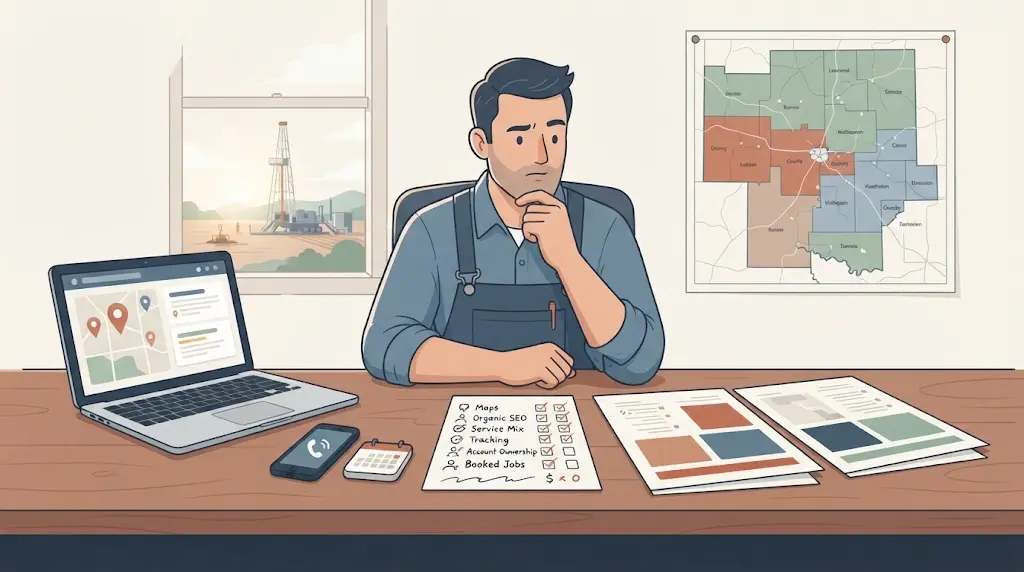
How should Brictale fit into the decision?
Brictale's role is to help a US well drilling or pump company find the gap between being visible and being chosen. That can mean a Maps problem, an organic service-page problem, a territory problem, a measurement problem, or an operating problem that should be fixed before more demand is created.
The existing well drilling SEO guide covers the broader search system for a well contractor. This comparison narrows the decision to Maps versus organic SEO and the sequence between them. If your company later wants to understand how search content can be found in AI-generated answers, the generative engine optimization reference explains that separate surface without changing the Google Maps versus organic decision made here.
The useful next step is a free territory audit. It should look at the real operating base, service mix, local profile, organic service pages, competitive visibility, call path, and the point where inquiries become or fail to become booked jobs. The output should be a prioritized decision, not a promise that every search surface needs more work.
What is the final decision for a well contractor?
Choose Google Maps first when nearby, call-led demand is the constraint and the profile or local trust path is weak. Choose organic SEO first when service complexity, project value, territory coverage, or missing explanations are the constraint. Choose both foundations when either channel would otherwise send the buyer to incomplete or conflicting information.
Then measure the path below the ranking. A profile view is not a job. An impression is not a job. A call is not always a qualified opportunity. The decision is working when the company can see which service and territory inquiries arrive, which ones fit, which become estimates, and which become booked work.
The best channel is the one that solves the next business constraint. Start there, connect it to the other surface, and keep the office record honest.